Last updated October 15, 2026
ADU Cost Breakdown: The Houston Homeowner’s Reference for 2026
The $150,000 ADU estimate you saw online is probably a California number. A comparable detached ADU in Houston runs $110,000 to $145,000 in 2026, and knowing why that difference exists is what keeps you from getting overcharged or choosing a contractor who cuts corners to hit the lower figure. Our Complete Guide to ADU in Houston breaks down real Houston costs by project type, line item, and hidden expense so you can walk into a contractor conversation knowing what a fair price actually looks like. We’ve built ADUs, garage conversions, and additions across Houston since 2010, and we’ve seen what happens when homeowners price their project with national numbers instead of local ones.
Quick Answer
A detached ADU in Houston costs $110,000 to $145,000 for a 600 to 800 square foot new build in 2026, a garage conversion runs $75,000 to $115,000, and a second-story addition lands between $180,000 and $240,000. These figures include Houston Permitting Center fees, foundation work suited to local clay soil, standard finishes, and professional labor. Your exact cost depends on square footage, finish level, site conditions, and whether you finance the project or pay cash.
Table of Contents
- Houston ADU Costs by Project Type: Real 2026 Numbers
- Why Houston Foundations Cost More Than You Expect
- Permit Fees and Carrying Costs at the Houston Permitting Center
- How to Read a Houston Contractor Bid Line by Line
- Financing vs. Cash: What Money Actually Costs in 2026
- Prefab ADUs in Houston: Cover, Dvele, and Boxabl Pricing
- Houston ADU Timeline: From Plans to Certificate of Occupancy
- Common Mistakes to Avoid
- When to Call a Professional
- Frequently Asked Questions
- The Bottom Line
Houston ADU Costs by Project Type: Real 2026 Numbers
National cost guides fail Houston homeowners because they average together markets with very different labor rates, soil conditions, and code requirements. Here’s what we actually see in Houston in 2026, broken down by the three main ADU types.
Detached New Build ADU: $110,000 – $145,000
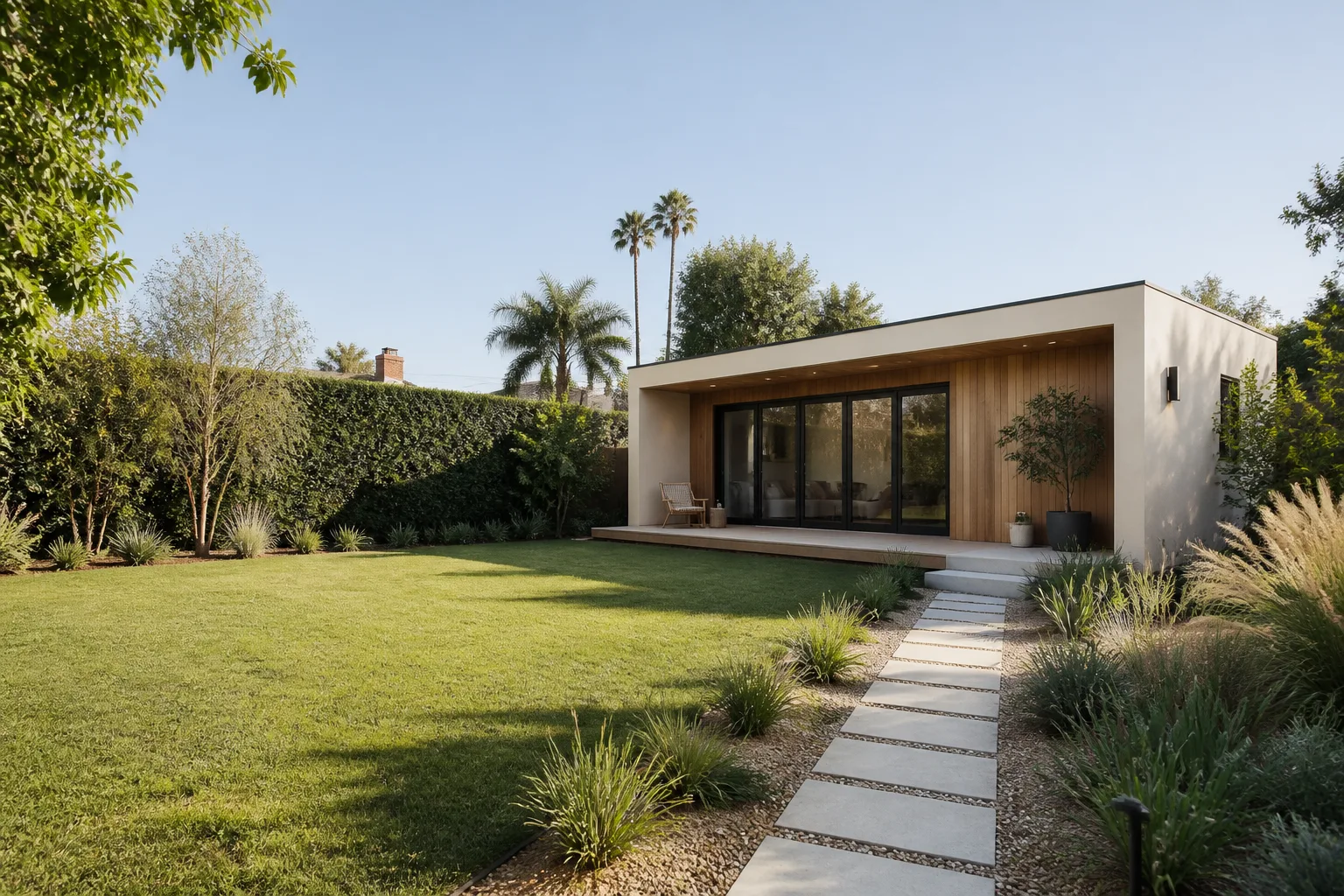
A detached accessory dwelling unit is a small house built separately from your primary residence, typically 600 to 800 square feet with one bedroom, one bathroom, and a small kitchen. This is the most expensive option per square foot because it requires its own foundation, utility connections, and full building envelope. Here’s where the money goes on a typical 700 square foot detached unit in Houston:
- Foundation (slab on grade): $9,000 – $14,000. Clay soil in Houston means soil testing and possibly a pier-and-beam design, which adds $4,000 to $8,000 over a standard slab.
- Framing and lumber: $18,000 – $26,000. Houston’s humidity means you need lumber rated for moisture exposure, and material costs have not returned to pre-2021 levels.
- Electrical rough-in and panel: $7,000 – $11,000. This includes running a new circuit from your main panel or, in some cases, adding a subpanel.
- Plumbing rough-in and fixture setting: $8,000 – $13,000. Tying into the city sewer line or adding a grinder pump changes this number significantly.
- HVAC (mini-split system): $5,000 – $8,000. Houston’s heat and humidity make a properly sized mini-split essential, not optional.
- Insulation and drywall: $6,000 – $9,000. Closed-cell spray foam is common here because it handles humidity better than fiberglass batts.
- Roofing: $5,000 – $8,000. A standing seam metal roof costs more up front but handles Houston’s storm season better than asphalt shingles.
- Interior finishes (flooring, cabinets, paint, tile): $18,000 – $30,000 depending on your taste.
- Site work and utility trenching: $5,000 – $10,000. Every lot is different. A long run from the street to the ADU adds real cost.
- Permits, plans, and engineering: $5,000 – $10,000. More on this below.
ADU Builders in Houston who work regularly in the city will have material pricing down to the board foot, which matters when a quote is $15,000 apart at the same square footage. You can also start at the Lodgewick ADU Houston home page to see how a Houston-specific ADU company structures estimates.
Garage Conversion: $75,000 – $115,000
A garage conversion turns your existing attached or detached garage into livable space. It is almost always cheaper than new construction because the foundation, walls, and roof already exist. What changes is everything behind the walls and what it takes to make a space built for cars meet code for people. Here’s a real line item breakdown for a typical 480 square foot two-car garage conversion in Houston:
- Slab inspection and repair: $1,500 – $4,000. Many Houston garages have thin slabs never meant to support living space. Cracks, settling, and moisture intrusion all need addressing before anything else happens.
- Electrical upgrade: $5,000 – $9,000. A garage typically has one or two outlets and a light fixture. You need a proper panel with circuits for a kitchen, lighting, and outlets throughout.
- Plumbing for kitchenette and bath: $7,000 – $14,000. If the garage is attached, running lines is straightforward. Detached garages need trenching and possibly a new sewer line, which pushes toward the top of this range.
- Floor leveling and elevation correction: $2,000 – $5,000. Houston garages are often sloped for drainage. Living space needs a level floor, and that means either pouring an overlay or grinding and leveling.
- Wall and ceiling finishing: $6,000 – $10,000. Exposed studs become insulated, drywalled, and painted walls.
- HVAC: $4,000 – $7,000. A garage conversion needs a conditioned air solution tied to your home’s system or its own mini-split.
- New opening treatments (where the garage door was): $3,000 – $6,000. You can replace the door with glass, infill with framing and siding, or add a wall with a window.
- Finishes: $12,000 – $20,000. Kitchenette cabinets, bathroom fixtures, flooring, and paint.
Garage Conversion Contractor in Houston specialists can usually save homeowners 15 to 30 percent versus a new build, but only when the existing structure is in good condition. We’ve seen garage conversions in Houston’s Meyerland and Braeswood areas hit six figures because the original slab had failed and needed full replacement.
Second-Story Addition (ADU Above Garage or Existing Structure): $180,000 – $240,000
Going up instead of out makes sense on small Houston lots, but it is the most structurally demanding ADU option. The existing structure has to carry the new load, which means engineering, possible foundation reinforcement, and more complex mechanical runs. A 600 square foot second-story addition in Houston typically looks like this:
- Structural engineering and framing modifications: $20,000 – $35,000. The existing walls and foundation may need reinforcement before vertical framing begins.
- Staircase: $8,000 – $15,000. Egress requirements mean a full staircase, not a narrow ladder-style access.
- Roof tie-in and weatherproofing: $10,000 – $18,000. Houston’s rain events are intense. Valley flashing and moisture barriers have to be detailed correctly or you’ll find leaks within the first year.
- Plumbing and electrical vertical runs: $12,000 – $20,000. Moving utilities up through existing walls doubles the labor compared to horizontal runs.
- Interior finishes: $25,000 – $45,000. Same square footage as a detached ADU but with more finish complexity due to roofline cuts and dormer work.
- Permits and engineering: $8,000 – $15,000. Second-story work triggers more structural review at the Houston Permitting Center.
Home Addition Contractor in Houston teams with second-story experience know what the city’s plan reviewers look for on these projects, which can save weeks of revision cycles.
Why Houston Foundations Cost More Than You Expect
Houston sits on expansive clay soil, and that changes everything about ADU pricing. Clay expands when it rains and contracts during dry spells. In a city that gets 50 inches of rain a year followed by stretches of drought, that movement is constant. A foundation that is not designed for this soil will crack, shift, and take your ADU with it.
The decision you’ll face is slab on grade versus pier-and-beam. A standard slab for a 700 square foot ADU runs $9,000 to $14,000 in Houston. But if your soil test shows high plasticity clay, your engineer may require a pier-and-beam foundation with piers driven 15 to 20 feet deep. That pushes your foundation cost to $15,000 to $22,000. We’ve seen homeowners skip the soil test to save $800 and end up spending $30,000 on foundation repair three years later.
Houston-specific factors that affect your foundation cost:
- Soil test: $800 – $1,500. Non-negotiable. The data drives the foundation design.
- Slab on grade: $9,000 – $14,000. Appropriate for lower-plasticity soils and smaller ADUs.
- Pier-and-beam with driven piers: $15,000 – $22,000. Required when soil movement risk is high. The piers anchor below the active clay layer.
- Drainage correction: $2,000 – $6,000. Many Houston lots need regrading or a French drain system to keep water away from the ADU foundation.
- Root barrier installation: $1,500 – $4,000. Houston’s large live oaks and pines send roots under foundations, and a barrier prevents post-construction heaving.
The most expensive foundation mistake we see in Houston is not the foundation itself. It is the homeowner who builds the ADU, then discovers the original home’s drainage system pushes water toward the new structure. Correcting site drainage after the fact costs two to three times what it would have during initial construction. A defined arrival window and a written scope that includes drainage assessment is part of how we approach every ADU in Houston.
Permit Fees and Carrying Costs at the Houston Permitting Center
The Houston Permitting Center handles ADU permits under the city’s Residential Building Code; see ADU Permits, Codes & Inspections in TX: What You Need to Know for deeper detail. Your permit costs are not a single fee. They are a stack of line items that change based on your project’s valuation, and they are due before construction starts. For a $120,000 detached ADU in Houston, expect the following:
- Building permit fee: $1,200 – $2,400. Calculated on project valuation. Houston’s fee schedule increments as valuation rises.
- Plan review fee: $400 – $900. Covers the first review cycle. Resubmissions may cost additional review fees.
- Electrical permit: $300 – $600.
- Plumbing permit: $300 – $600.
- Mechanical (HVAC) permit: $200 – $450.
- Impact fees and utility connection fees: $1,500 – $4,000 depending on where your lot sits in Houston’s service territory.
- Sidewalk and right-of-way bond (if applicable): $500 – $1,500. Only triggered if your ADU construction affects the public right-of-way.
Total permit cost for a typical Houston ADU lands between $4,500 and $10,000. But the permit fees are not the real cost. The real cost is the carrying cost of waiting. Houston’s plan review for ADUs currently averages 6 to 12 weeks from submission to approval, depending on workload and whether your plans include everything the reviewer needs the first time. If you are paying for a construction loan or a HELOC draw during that window, interest accrues. If you are renting elsewhere while the ADU is built, rent accrues. If you are paying a contractor to hold a slot, that may accrue too.
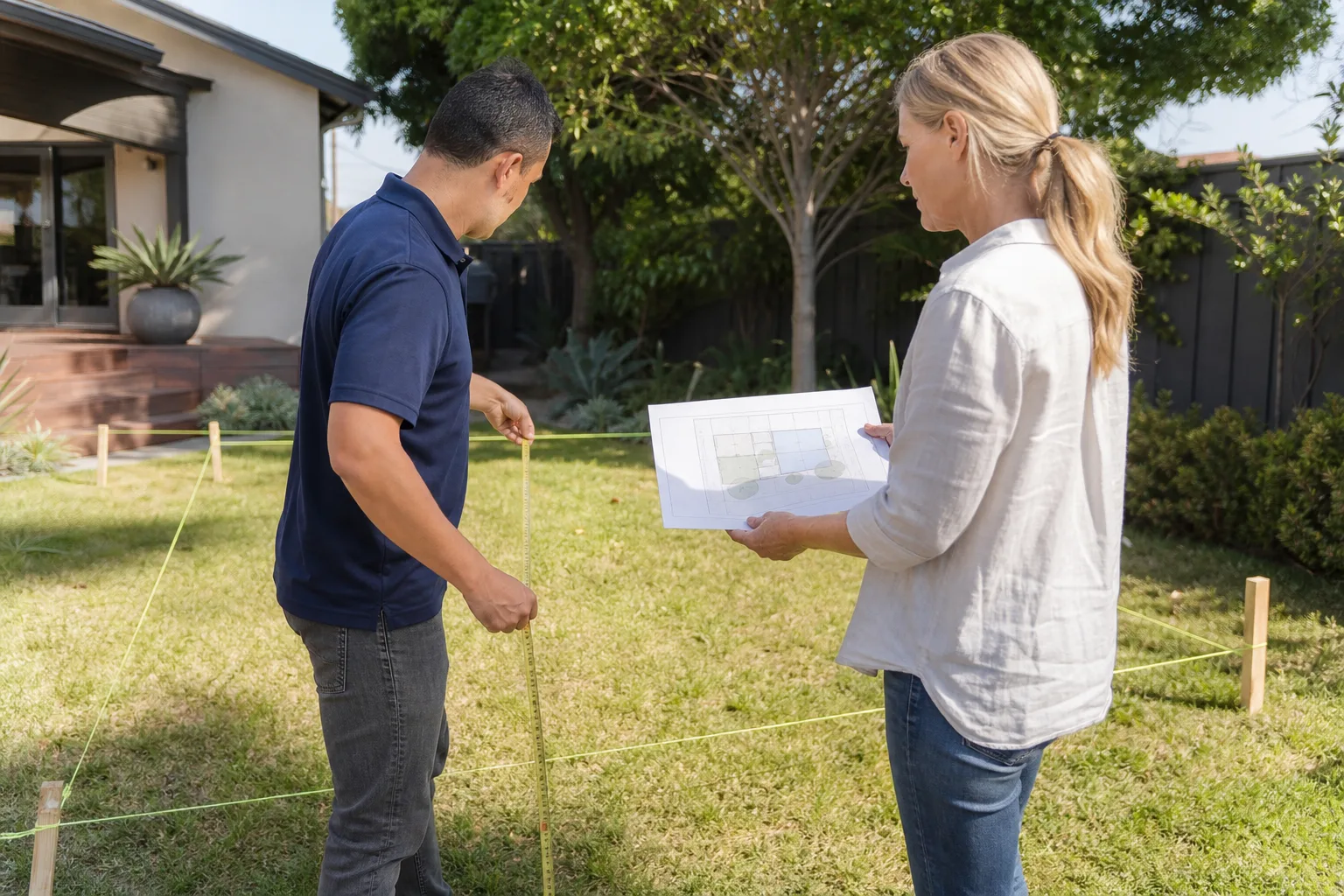
What you can control: submit complete plans. Incomplete plan sets are the number one delay at the Houston Permitting Center. A contractor or designer who knows the city’s ADU requirements reduces resubmission cycles, and fewer cycles mean lower carrying costs. We tell Houston homeowners to budget 8 to 14 weeks from plan submission to permit in hand, and to ask any contractor how many of their Houston ADU permit applications pass first review. The answer tells you more than the bid does.
How to Read a Houston Contractor Bid Line by Line
A $110,000 quote and a $140,000 quote for the same Houston ADU are often not for the same project at all. The difference hides in the allowances, exclusions, and small print. Here is how to read a bid so you know which number is real.
- Start with the scope of work, not the price. If the bid does not describe exactly what is included, room by room, the number is meaningless. A bid that says “ADU complete” with no detail is a starting point for negotiation, not a commitment.
- Look for the allowance line items. Allowances are the contractor’s estimate for materials like cabinets, countertops, flooring, and fixtures. A bid with $4,000 for kitchen cabinets is reasonable for builder-grade particle board. If you want plywood boxes or soft-close hardware, that allowance changes on paper and in your final bill.
- Check the exclusions section. This is where missing costs hide. Common Houston ADU bid exclusions: tree removal, soil testing, drainage work, utility connection fees, appliance purchase, and window treatments. Each of these can add $1,500 to $8,000.
- Verify who pulls permits. Some Houston contractors quote the work but require the homeowner to pull permits in their own name. That shifts liability and responsibility onto you. Ask directly: who is the permit holder on record?
- Confirm the foundation scope in writing. If the bid says “slab on grade” but your soil test recommends piers, the change order comes after demolition starts. That is how a $30,000 surprise shows up in month two.
- Ask about the change order process. Every contractor runs into unknown conditions on Houston lots. The question is not whether change orders happen. The question is how they are priced and approved. A written change order process with prices agreed before work proceeds protects you.
At Lodgewick ADU Houston, the written price is delivered before any work starts, and the scope spells out what is included and what is excluded so the number on the quote is the number you plan around. Russ Delmar has made that the standard on every project since 2010, because a price that changes at the door is not a price at all.
Financing vs. Cash: What Money Actually Costs in 2026
The cost of your ADU is not just the construction price. It is the construction price plus whatever you pay to access the money. In 2026, Houston homeowners are financing ADUs through three primary routes, and each changes the true project cost.
HELOC (Home Equity Line of Credit)
A HELOC uses your existing home equity as collateral. Interest rates in 2026 run roughly 8 to 10 percent, charged only on the amount you draw. If you draw $120,000 over a 9-month project and pay it back over 10 years, the interest adds $48,000 to $60,000 to the total cost. The advantage is flexibility: you draw as needed, which matches construction milestones. The disadvantage is variable rates and the risk of your home securing the debt.
Cash-Out Refinance
If you locked a low mortgage rate years ago, refinancing to pull cash for an ADU likely means giving up that rate for a 2026 rate around 6.5 to 7.5 percent. That is a meaningful lifetime cost increase on the entire mortgage, not just the ADU portion. Run the numbers on the blended rate before choosing this route.
Construction Loan
Construction loans have higher rates than HELOCs, generally 9 to 11 percent, and charge interest on the full approved amount once draws begin. However, they convert to a permanent mortgage after construction, which can be simpler than managing a separate HELOC. Total added cost on a $120,000 loan with a 10-month build and 15-year amortization lands in the $65,000 to $85,000 range in interest.
Cash is simplest and cheapest. If you have the liquidity, paying cash eliminates every financing line item and lets you negotiate from a stronger position, some Houston contractors discount cash projects by 2 to 4 percent because they avoid draw inspections and lender paperwork. For homeowners who need financing, the recommendation we give in Houston is this: get your financing approved before you sign a construction contract. A contractor should never be the reason you rush a loan decision.
Prefab ADUs in Houston: Cover, Dvele, and Boxabl Pricing
Factory-built ADUs from companies like Cover, Dvele, and Boxabl are changing what Houston homeowners can build, but the delivered-and-installed price is not the same as the factory price. Here is how these options pencil out in Houston in 2026.
Cover ADU
Cover builds panelized ADUs designed for precise site assembly. A 600 square foot unit with one bed and one bath typically runs $180,000 to $240,000 delivered and installed in Houston. That includes the factory build, transport from California, site foundation work, utility connections, and assembly. The Houston-specific costs are foundation and utility work, which add $20,000 to $35,000 over the factory price.
Dvele
Dvele positions itself as a health-focused prefab builder with higher-end finishes and integrated smart home systems. A 750 square foot Dvele unit in Houston lands between $240,000 and $320,000 installed. The premium reflects the finish level and the brand’s full-home systems approach. For a Houston lot with drainage or access challenges, Dvele’s installation team coordinates site work, but the local foundation and utility costs remain the homeowner’s addition.
Boxabl
Boxabl’s Casita is a 375 square foot accessory dwelling unit with a known factory price under $70,000 for the unit itself. Delivered and installed in Houston, with foundation, utility hookups, and finishing, expect $110,000 to $140,000 total. The Casita is the fastest option: some Houston installations complete in 60 to 90 days from delivery, not counting permit time. The tradeoff is customization. You get the Boxabl layout as designed, with limited modification options.
Prefab does not eliminate Houston-specific costs. The foundation still has to suit clay soil, utilities still need to be trenched and connected, and the Houston Permitting Center still needs to approve the plans. What prefab does eliminate is weather delay on the framing and rough-in phases, because most of that work happens in a controlled factory environment. For Houston homeowners who want a fixed delivery date and less on-site construction time, prefab is worth the premium. We work with these systems regularly and can match the right one to your lot, budget, and timeline.
Houston ADU Timeline: From Plans to Certificate of Occupancy
Knowing how long an ADU takes in Houston helps you plan carrying costs, financing draws, and family logistics. Here is the full sequence, from first phone call to final inspection.
- Design and engineering (weeks 1 to 6): Your designer drafts the ADU plans, your engineer reviews the foundation and structural details, and your soil test happens during this window. Expect $5,000 to $12,000 for design and engineering combined.
- Plan submission and review (weeks 6 to 18): Plans go to the Houston Permitting Center. First review cycles average 6 to 12 weeks. Resubmissions add 2 to 4 weeks each. A complete initial submittal is the single biggest schedule lever.
- Permit issuance and pre-construction (weeks 18 to 20): Fees are paid, the permit is issued, and your contractor schedules the work. Site protection and material ordering begin.
- Foundation and site work (weeks 20 to 24): Excavation, formwork, pour, and cure. Pier-and-beam takes slightly longer than slab. During Houston’s rainy season, expect weather days added here.
- Framing, roofing, and envelope (weeks 24 to 30): Walls go up, the roof goes on, and the structure is dried in. Houston humidity means the envelope has to be tight before interior work starts.
- Mechanical rough-in (weeks 30 to 34): Electrical, plumbing, and HVAC lines run through the open walls. Inspections happen at the end of this phase.
- Insulation, drywall, and finishes (weeks 34 to 42): Insulation goes in, drywall goes up, and finish surfaces start appearing. This is the phase where your material selections matter most.
- Final inspections and Certificate of Occupancy (weeks 42 to 46): The city inspects the completed work, and the Certificate of Occupancy is issued. Your ADU is legally habitable.
Total timeline: 10 to 12 months in Houston, with permitting being the biggest variable. The construction itself is 4 to 6 months, but the pre-construction window of design and permitting controls whether you are living in your ADU this time next year or still waiting on a resubmission.
Common Mistakes to Avoid
- Skipping the soil test to save $800. Houston’s clay soil does not care about your budget. The test is the cheapest insurance you’ll buy on an ADU project, and skipping it turns a $12,000 foundation into a $30,000 repair.
- Comparing bids without comparing scope. A $105,000 bid with foundation, permits, and drainage included is cheaper than a $95,000 bid that excludes all three. Line-item comparison is the only real comparison.
- Under-budgeting for HVAC. Houston ADUs need real air conditioning, properly sized for the square footage and Houston’s humidity. A $2,500 window unit is not an HVAC system, and your tenants or family will know the difference within a week.
- Not checking utility connection costs before signing. A lot on a cul-de-sac in Oak Forest may have a sewer line 80 feet away, while a lot in Garden Oaks might have one 15 feet away. That difference is $5,000 to $12,000 on the same size ADU.
- Choosing a contractor who will not pull permits. An unpermitted ADU in Houston means no Certificate of Occupancy, which means no legal rental income, insurance problems, and resale disclosure issues. The discount is never worth it.
- Ignoring drainage until after construction. Water that pools against your new ADU foundation will find its way in. Drainage correction during construction is a line item. Drainage correction after construction is a crisis.
- Assuming prefab means turnkey. Factory-built ADUs still need Houston foundations, Houston utility connections, and Houston permits. The factory price is the starting line, not the finish line.
When to Call a Professional
You should bring in an ADU specialist before you make any financial commitments. That means before you sign a financing agreement, before you buy a prefab unit, and definitely before you start clearing land. A professional who builds ADUs in Houston weekly can tell you whether your lot drains properly, whether your existing garage slab is worth saving, and whether your budget lines up with the scope you want. If you are seeing bids that are $30,000 apart for the same described project, call someone who will walk the lot with you and explain why. The Kingswell Guarantee means a written price before work begins, a defined arrival window, a clean job site, and a written guarantee on every job. Lodgewick ADU Houston offers free estimates in Houston. Call (361) 326-2313 to schedule yours.
Frequently Asked Questions
A detached ADU in Houston costs $110,000 to $145,000 for a new build of 600 to 800 square feet, a garage conversion runs $75,000 to $115,000, and a second-story addition lands between $180,000 and $240,000. Your price depends on square footage, finish level, foundation requirements, site conditions, and whether you finance. Call (361) 326-2313 for an exact quote based on your lot.
Not if the written scope is complete and the change order process is defined. What changes are unknown conditions: a cracked garage slab discovered after demo, a sewer line that is further than expected, or a soil report that requires deeper piers. A contractor using The Kingswell Guarantee puts the price in writing before work starts and handles changes with written change orders priced before the additional work proceeds. Ask about change order policy before signing anything.
Yes. Every ADU in Houston requires building, electrical, plumbing, and mechanical permits through the Houston Permitting Center. Building without permits means no Certificate of Occupancy, which creates rental income, insurance, and resale problems. Total permit cost runs $4,500 to $10,000 for a typical ADU.
Plan on 10 to 12 months from the day you start design to the day you receive your Certificate of Occupancy. Construction itself is 4 to 6 months, but Houston Permitting Center review windows add 6 to 12 weeks or more before construction can legally begin. Incomplete plans are the biggest schedule killer.
Yes, generally by 25 to 35 percent. A garage conversion in Houston runs $75,000 to $115,000 because the foundation, walls, and roof already exist. The savings disappear if the existing slab has failed, because replacing a garage slab costs close to what a new detached foundation costs. A Garage Conversion Contractor in Houston can tell you early whether your garage is a good candidate.
Not consistently. A Boxabl Casita delivered and installed in Houston runs $110,000 to $140,000, which is comparable to a site-built detached ADU at the lower end. Cover and Dvele units run higher because of their finish levels and system integration. Prefab saves time and weather risk, not usually money.
The Bottom Line
Houston ADU costs in 2026 are real, knowable numbers: $110,000 to $145,000 for a detached unit, $75,000 to $115,000 for a garage conversion, and $180,000 to $240,000 for a second-story addition. The spread between a fair bid and a padded one comes down to scope clarity, foundation honesty, permit experience, and a written change order process. The Kingswell Guarantee exists because homeowners deserve a price in writing before work starts, a real arrival window, a clean job site, and a written guarantee that comes back if the work fails. When you are ready to price your ADU, call (361) 326-2313 for a free estimate and a real number, not a ballpark, and explore more guides & resources to keep planning.
Written by Russ Delmar, Owner at Lodgewick ADU Houston, serving Houston since 2010.