Last updated October 15, 2026
The Complete Guide to ADU in Houston
Houston has no citywide zoning code, which sounds like a builder’s paradise – until you discover that your specific block’s deed restrictions can kill an ADU project the same week permits are approved. The city will happily take your permit application for a detached backyard unit, a garage conversion, or a second-story addition. But the people who actually control what gets built on your lot are often a homeowners association board or a decades-old covenant written before accessory dwelling units were even a concept. This guide walks the actual path from raw idea to rent-ready unit in Houston, with real dollar figures, permit timelines, and the structural realities of building on Gulf Coast clay.
Quick Answer
Building an ADU in Houston typically costs between $140,000 and $320,000 for a detached unit, $90,000 to $180,000 for a garage conversion, and $180,000 to $400,000 for a second-story addition, with 6 to 14 months from design to move-in. Houston’s lack of zoning means the city itself rarely blocks an ADU, but deed restrictions, HOA covenants, MUD district rules, and floodplain overlays often do. Checking those restrictions before spending money on design is the single most important step in the entire process.
Table of Contents
- Houston’s ADU Rules: What the City Actually Allows
- Deed Restrictions and HOA Covenants: The Real Gatekeepers
- MUD Districts, Floodplains, and What They Mean for Your ADU
- What ADUs Cost in Houston, by Type
- The Houston Permitting Path, Step by Step
- Building for Houston’s Soil and Wind: What ‘Done Right’ Means
- Prefab vs. Stick-Built ADUs in Houston
- Common Mistakes to Avoid
- When to Call a Professional
- Frequently Asked Questions
- The Bottom Line
Houston’s ADU Rules: What the City Actually Allows
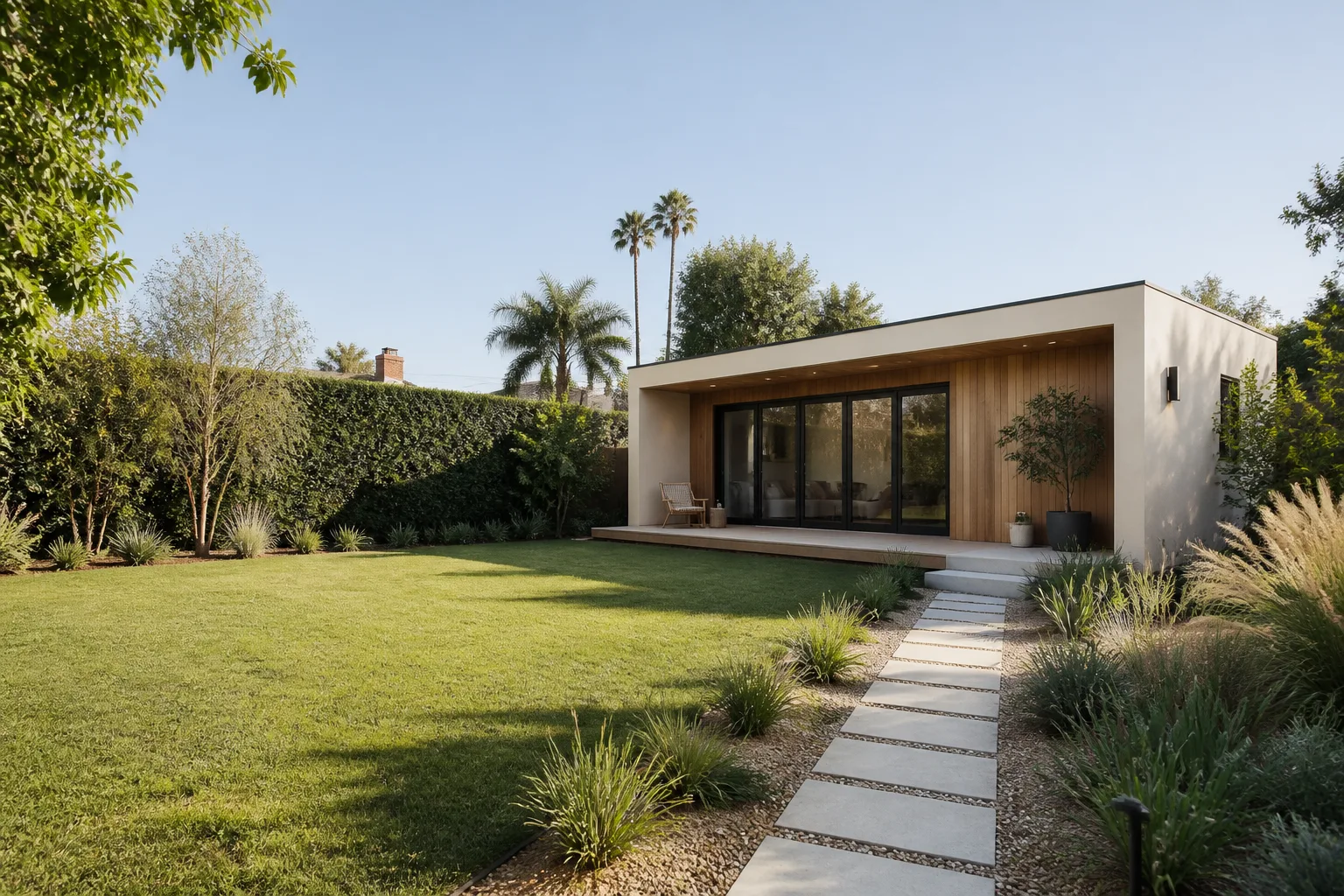
Houston’s lack of zoning is the reason an ADU conversation here is fundamentally different from one in Austin, Dallas, or any other major Texas city. In most cities, zoning law tells you where an accessory dwelling unit can go, how big it can be, and whether you can rent it. Houston never adopted a zoning code, which means the city’s Chapter 42 development ordinance governs what you can build, and it is remarkably permissive compared to zoning-based cities. A single-family lot in Houston can generally accommodate a detached ADU up to 1,000 square feet, or roughly 10% of the lot area, whichever is smaller. That’s real usable space, not a glorified shed.
The city’s rules focus on setbacks, height limits, lot coverage, and parking. A detached ADU typically needs to sit at least 3 feet from side and rear property lines. Height is capped at 25 feet for accessory structures. Lot coverage – the total footprint of all buildings combined – cannot exceed 65% of the lot in most cases. These are not suggestions. Houston’s permitting center reviews all of it, and a variance is not guaranteed just because your neighbor built something bigger in 1998.
The bigger point: Houston does not prohibit you from renting an ADU to a non-family member. Some Texas cities restrict ADU occupancy to family or caretakers. Houston does not. That makes an ADU a genuine income-producing asset in most of the city and the surrounding county pockets, which is a major factor when homeowners run the numbers. We point this out early because almost every national ADU guide gets it wrong when they apply California-style rules to Texas.
Deed Restrictions and HOA Covenants: The Real Gatekeepers
Here is the part most guides never mention. The City of Houston will happily accept your ADU permit application. What the city will not do is check your deed restrictions before approving it. That’s on you, and the deadline to discover a problem is not “before construction starts” but before you pay a designer a single dollar.
Houston grew through waves of subdivision development, and a huge share of its residential land carries private deed restrictions that run with the property. These restrictions predate the city’s ADU-friendly posture by decades. Many were written in the 1950s through 1980s and contain language like “single-family residential use only” or “one dwelling per lot.” That language can be read to prohibit an ADU even when the city says the structure is perfectly legal. An HOA, if one exists, can enforce the restriction in court, and they win those cases regularly in Harris County.
Here’s how to check yours before spending money:
- Locate your deed. The title commitment from when you bought the home lists recorded restrictions. The Harris County Clerk’s public records system also lets you search by legal description and subdivision name.
- Read the exact language. Look for phrases like “single-family,” “one residence,” “no additional structures,” or “garage only.” Words matter. A restriction that says “no trailers or temporary structures” probably doesn’t block an ADU. One that says “one single-family dwelling per lot” very likely does.
- Check for an active HOA. If your subdivision has one, pull the current covenants, conditions, and restrictions (CC&Rs), not the original 1970s deed language. HOAs amend documents, sometimes in ways that loosen old rules, sometimes in ways that tighten them.
- Look at the enforcement history. Some deed restrictions exist on paper but have never been enforced for 20 years, which can create a legal defense based on abandonment. That’s a conversation for a real estate attorney, not a builder guessing.
- If the restriction blocks you, get a legal opinion on a variance request to the HOA or a release from the restriction. Some HOAs now grant ADU exceptions because property values in Houston neighborhoods with ADUs have held up well.
We tell every Houston homeowner the same thing: the city permit is the easy part. The deed restriction is the part that determines whether the project happens at all. If you’re in an HOA neighborhood and want a Garage Conversion Contractor in Houston to give you a real number, confirm the restriction question first. It saves everyone the heartbreak of pricing a project that can’t legally start.
MUD Districts, Floodplains, and What They Mean for Your ADU
Houston’s utility and drainage reality adds two layers that national ADU guides completely miss: Municipal Utility Districts (MUDs) and floodplain overlays. Both can change a project’s cost by tens of thousands of dollars, and both are discoverable before you commit.
MUDs are special-purpose districts that provide water, sewer, and drainage infrastructure in unincorporated parts of Harris County and many Houston subdivisions. If your home’s water and sewer service comes through a MUD, that district has rules about new connections and additional dwelling units. Some MUDs charge tap fees for a second water meter or an additional sewer connection that run from $5,000 to $15,000. Others flatly require the ADU to share the primary home’s water service, which affects plumbing design and sometimes whether the ADU gets its own address. You find this out by calling your MUD’s operator – the name is on your water bill – and asking directly about accessory dwelling unit connections. Do not assume the city’s rules override the MUD. The city does not operate your water service in many parts of the metro.
Floodplain is the second layer, and Houston homeowners understand this after Harvey. If your lot sits in a FEMA-designated Special Flood Hazard Area, a detached ADU adds new impervious cover and often requires a finished floor elevation above the Base Flood Elevation. That can mean a raised foundation, additional fill, or a pier-and-beam design that adds $20,000 to $50,000 before you even frame a wall. Harris County’s drainage rules also impose detention requirements for large additions. A 1,000-square-foot ADU usually doesn’t trigger detention, but a larger second-story addition or oversized detached unit can. Check the Harris County Flood Control District’s interactive map and your property’s elevation certificate before you spend on architectural drawings. We’ve seen projects in Meyerland and Kingwood where the floodplain number, not the construction number, was the one that mattered.
What ADUs Cost in Houston, by Type
Houston ADU costs run lower than coastal markets but higher than most online estimators suggest, because those estimators use national lumber, labor, and soil assumptions that don’t match Gulf Coast construction. Here are the real 2025 ranges we see for Houston-area projects.
Detached ADU (Backyard Unit)
- Basic 400 – 600 sq ft studio: $140,000 – $180,000
- 600 – 800 sq ft one-bedroom: $180,000 – $250,000
- 800 – 1,000 sq ft two-bedroom: $250,000 – $320,000
- Per-square-foot cost: $280 – $380 depending on finishes, foundation type, and utility distance
These figures include architectural drawings, permits, utility connections, and standard finishes. Houston’s competitive framing labor market helps keep lumber labor lower than Austin, but foundation work on clay soil adds cost that offset it.
Garage Conversion
- Attached garage conversion (typical 2-car, ~400 sq ft): $90,000 – $140,000
- Detached garage conversion: $110,000 – $180,000, more if the slab needs replacement or the roof structure is undersized
- Per-square-foot cost: $220 – $300, because the shell already exists and the savings go into plumbing, electrical, insulation, and windows
A garage conversion in Houston often costs less than a ground-up ADU but carries hidden costs: raising the slab for flood compliance, adding a bathroom where no plumbing exists, and bringing the old garage’s electrical service up to current code for a dwelling unit. We walk homeowners through all of it in writing before work starts. A Garage Conversion Contractor in Houston who won’t put the number in writing is not worth the call.
Second-Story Addition
- 400 – 600 sq ft vertical addition over existing structure: $180,000 – $280,000
- Larger 600 – 900 sq ft addition: $280,000 – $400,000
- Per-square-foot cost: $350 – $450, because you’re cutting open the existing roof, reinforcing the first-floor framing, and coordinating the family living below during construction
Second-story ADUs make sense on small lots where there’s no room for a detached unit. They carry engineering requirements the other types don’t: the existing foundation and first-floor wall framing have to carry the added load. On Houston’s expansive clay, that often means foundation inspection, possible slab repairs, and additional framing connectors. A thorough Home Addition Contractor in Houston will flag this in the estimate, not after demo starts.
None of these ranges are national averages. They’re what we price and build in Houston, where the wind load requirements, the clay soil, and the MUD connection fees are part of every project. Free estimates are the only way to get an exact number for your specific lot, but any contractor should be able to give you a written ballpark before the first site visit. If they won’t, walk.
The Houston Permitting Path, Step by Step
The Houston Permitting Center at 1002 Washington Avenue processes ADU permits through the city’s iPermits system. Here’s the path a typical project follows, with realistic timeline expectations in 2025:
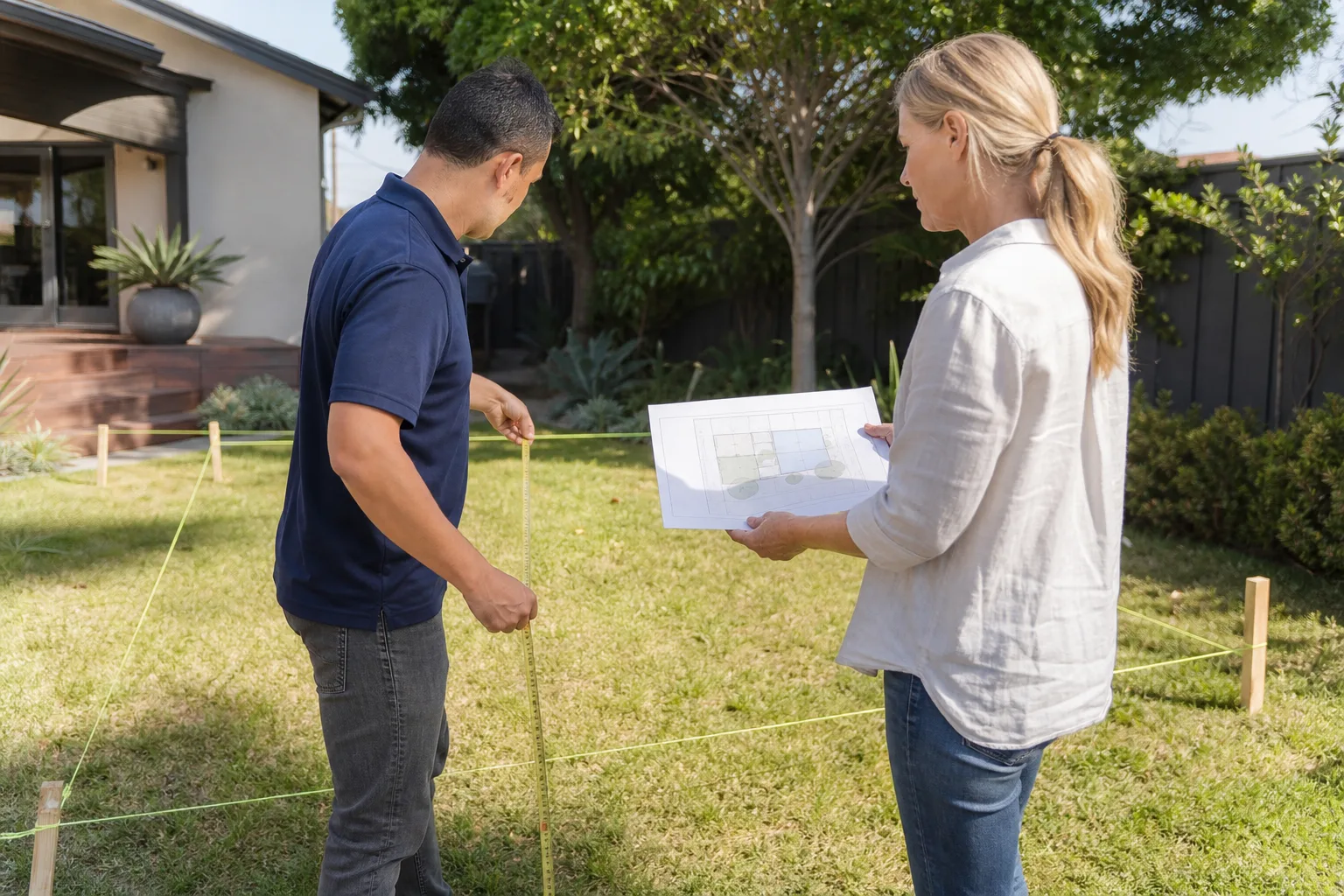
- Pre-application research (weeks 1 – 2). Verify deed restrictions, HOA covenants, MUD requirements, and floodplain status. Order a survey and an elevation certificate if needed. This is the step most skipped, and the step that kills the most projects late.
- Site survey and soil test (weeks 2 – 4). A registered Texas surveyor locates your lot lines, easements, and existing structures. A geotechnical engineer tests the soil to determine foundation design. On Houston’s expansive clay, this is not optional.
- Architectural and structural drawings (weeks 4 – 10). A Texas-licensed architect or engineer prepares plans showing the ADU’s size, setbacks, height, materials, and structural systems. Wind load calculations for the Houston area are required, and the drawings must specify them.
- Plan submission to the Houston Permitting Center (weeks 10 – 12). Submit through iPermits. Typical plan review time for a simple ADU is 2 to 4 weeks. Anything requiring floodplain review, variance, or MUD sign-off adds 2 to 6 weeks.
- Permit issuance (weeks 12 – 16). Once plans clear review and fees are paid, the building permit is issued. Houston’s permit fees for an ADU typically run $2,000 to $6,000 depending on valuation and square footage.
- Construction and inspections (months 4 – 12). Foundation, framing, mechanical, electrical, plumbing, and final inspections happen at defined stages. Each must pass before the next begins. Houston inspectors schedule quickly, but re-inspection fees apply if work fails.
- Certificate of occupancy (month 12 – 14, typically). The final step. This certificate means the ADU is legal to occupy and rent. Without it, the building is a very expensive storage shed.
Total timeline for a typical Houston ADU: 6 to 14 months from first phone call to certificate of occupancy, with plan review and weather delays being the two biggest variables. Houston’s permitting center has improved timelines steadily, but floodplain reviews and MUD coordination still stretch schedules. Plan on the longer end of the range if your lot sits in a flood zone or MUD.
Building for Houston’s Soil and Wind: What ‘Done Right’ Means
Houston’s construction challenges are not random. They are specific, predictable, and expensive to fix when ignored. Here’s what ‘done right’ means for an ADU in this city’s conditions.
Expansive clay soil. The Houston area sits on expansive clays that swell when wet and shrink when dry. This movement is the single biggest cause of foundation failure in the region. A properly engineered ADU foundation accounts for it through pier-and-beam design, post-tensioned slabs, or drilled piers that reach stable soil. We never pour a slab on Houston clay without a geotechnical report, because we’ve seen what happens when someone does: cracked walls within two years, doors that stop closing, and a foundation repair bill that costs more than the original slab. The ADU Builders in Houston who do this right build the foundation for the soil it sits on, not the soil they wish it sat on.
Hurricane wind loads. Houston sits in a hurricane-prone region, and the International Residential Code (with Texas amendments) requires structures to resist significant uplift and lateral wind forces. ‘Done right’ means hurricane ties at roof-to-wall connections, reinforced wall-to-foundation anchors, and rated windows or shutter systems if the ADU is within the wind-borne debris zone. These are code minimums. Cheap builders skip the ones the inspector doesn’t catch, and the next storm finds them.
Moisture and humidity. Houston’s humidity means an ADU needs a vapor barrier under the slab, proper flashing at every penetration, and HVAC sized for dehumidification, not just cooling. A unit that’s cold but clammy is a design failure. We specify HVAC with sensible heat ratios matched to Gulf Coast humidity, because a dry 75 degrees is the only 75 degrees that feels right here.
Siding and exterior materials. Houston’s rain, heat, and occasional freeze cycles punish cheap siding. We work with James Hardie fiber cement and other engineered products because they hold up to this climate better than wood or vinyl. The material choice isn’t aesthetic. It’s about whether the exterior still looks right in year eight.
These are not optional upgrades. They’re what separates an ADU that’s still dry, straight, and rental-ready in 10 years from one that starts showing problems in year two.
Prefab vs. Stick-Built ADUs in Houston
Houston homeowners increasingly ask about prefab ADU options, and the honest answer is that prefab works well in this market when matched to the right lot and expectations. Prefab units from manufacturers like Abodu and Cover arrive as factory-built modules that get craned or assembled onto a prepared foundation. That approach can cut on-site construction time from months to weeks and reduce weather-related delays, which in Houston means dodging spring storms and summer heat.
What prefab does not eliminate is the Houston-specific groundwork. The foundation still has to be engineered for expansive clay. The unit still has to meet Gulf Coast wind load requirements, which some West Coast prefab manufacturers address with optional engineering packages. Utility connections still run through the same MUD or city processes. And the crane or assembly crew still needs a lot accessible enough to place a module, which eliminates prefab as an option for many Houston lots with narrow side yards or overhead power lines.
Stick-built ADUs remain the default for most Houston projects because they adapt to any lot shape, any flood elevation requirement, and any custom layout. Tuff Shed and similar products can serve as a garage shell or workshop converted into livable space, but converting one into a legal dwelling requires the same foundation, insulation, plumbing, and electrical work as any other build. Prefab is a legitimate path, not a shortcut around Houston’s soil, wind, and utility realities. We evaluate both approaches honestly for every lot, because the right answer changes block by block.
Common Mistakes to Avoid
- Paying for architectural drawings before checking deed restrictions. We see this monthly. The drawings are beautiful, the HOA says no, and the homeowner is out $5,000 to $12,000. Check the restriction first.
- Assuming Houston’s no-zoning reputation means no rules. The city has setback, height, coverage, and parking requirements. A permit is required. Building without one risks fines, stop-work orders, and a worthless structure at resale.
- Ignoring the floodplain until the plan review flags it. By then you’ve paid for drawings that don’t meet elevation requirements, and you’re paying the architect twice.
- Underestimating utility connection costs. Running water, sewer, and electrical service to a detached ADU across a 100-foot lot can cost $15,000 to $30,000 in Houston, more if trenching hits rock or runs under a driveway. No honest price ignores this line item.
- Choosing a contractor on price alone. Houston’s ADU market includes every kind of operator. A written price before work starts and a written guarantee after aren’t extras. They’re the baseline you should demand.
- Building a garage conversion without addressing the slab and roof. Most garages were never built to be living space. The slab may sit below grade, the roof may be under-framed for ceiling insulation, and the electrical service may be undersized. Skipping the structural work means a unit that’s technically permitted and genuinely uncomfortable.
- Forgetting about parking and access. Some Houston deed restrictions require off-street parking that an ADU could eliminate. Check before you lose a driveway space your HOA won’t let you live without.
When to Call a Professional
An ADU is a real building, not a DIY weekend project. If your lot has floodplain complications, a MUD connection, HOA restrictions you need help navigating, or soil conditions that demand a geotechnical report, a professional who has built in Houston’s specific regulatory and structural environment will save you more than their fee in avoided rework. The same applies if you’re a landlord planning to rent the unit: code compliance, insurance, and tenant safety are not places to improvise. Lodgewick ADU Houston home offers free estimates in Houston. Call (361) 326-2313 to talk through your lot, your timeline, and your real numbers. A live person answers every call, 24/7, not a voicemail loop and not a chatbot. We’ll give you a written price before any work starts, and the written guarantee comes with it.
Frequently Asked Questions
An ADU (accessory dwelling unit) is a second, smaller dwelling on the same lot as a primary home – think a backyard cottage, a converted garage, or a second-story addition. Houston allows detached ADUs, attached ADUs, garage conversions, and vertical additions, subject to setback, height, lot coverage, and floodplain rules. Deed restrictions may further limit what you can build on your specific lot. Call (361) 326-2313 for a free estimate that accounts for your property’s exact constraints.
A detached ADU in Houston typically costs $140,000 to $320,000, a garage conversion $90,000 to $180,000, and a second-story addition $180,000 to $400,000, depending on size, site conditions, and finishes. These ranges reflect Houston’s labor, material, and foundation costs, not national averages. We provide a written price before any work starts, so you know your real number up front – call (361) 326-2313 for an exact quote on your lot.
Yes. All ADUs in Houston require a building permit through the Houston Permitting Center, and most also require separate electrical, plumbing, and mechanical permits. A certificate of occupancy at the end is mandatory before the unit can legally be rented or occupied. The permit process typically takes 4 to 16 weeks depending on floodplain review and MUD coordination.
Yes, and this is the most common reason ADU projects in Houston die. A deed restriction or HOA covenant that limits the lot to one single-family dwelling can override the city’s permissive stance, and HOAs in Harris County routinely win enforcement cases. Check your deed and current HOA documents before paying for any design work.
Most Houston ADU projects take 6 to 14 months from the first site visit to the certificate of occupancy. Design and permitting typically take 3 to 5 months, and construction takes 4 to 12 months depending on project type, weather, and inspection schedules. Prefab units can shorten on-site construction but not the foundation, permit, and utility phases.
Yes. Houston does not restrict ADU rentals to family members or caretakers, which makes an ADU a legitimate long-term rental or short-term rental income source in most of the city. HOA rules and deed restrictions may still prohibit rentals, so check those documents before counting on rental income. Rental income changes your property insurance requirements too, so talk to your agent before the first tenant moves in.
The Bottom Line
Houston is one of the most ADU-permissive major cities in the country, but the city’s no-zoning reputation hides the real decision-makers: deed restrictions, HOA covenants, MUD districts, and floodplain overlays. Check all four before spending money, budget realistically for Houston’s soil and wind requirements, and get a written price with a written guarantee before agreeing to anything. That’s how a Houston ADU project goes from “we should look into this” to rent-ready and legal, without a surprise at any step along the way. For more guides & resources on Houston ADU construction, explore our blog. Lodgewick ADU Houston has built in this environment since 2010, and every project gets The Kingswell Guarantee: written price first, real arrival window, clean job site, written guarantee on every build. Call (361) 326-2313 and talk to a live person about your lot.
Written by Russ Delmar, Owner at Lodgewick ADU Houston, serving Houston since 2010.