Last updated October 15, 2026
ADU Permits, Codes & Inspections in TX: What You Need to Know
A Houston homeowner spent eleven months and roughly $62,000 getting her backyard ADU fully framed before discovering her address fell under Harris County’s unincorporated jurisdiction, not the City of Houston. The inspector who showed up to sign off on the work was from a completely different office, operating under a different code, and he could not legally approve what she had built. The fix added four months and $17,000 in plan revisions. This guide explains how to avoid that exact situation: how Texas ADU rules actually work, how to determine which jurisdiction governs your Houston-area property before you build, what the permit packet requires, which inspections matter, and what the recent legislative changes under SB 1412 mean for homeowners who want to build by right. For a deeper dive, see The Complete Guide to ADU in Houston.
Quick Answer
Texas has no statewide ADU permit code, which means the rules that govern your project depend entirely on where your property sits: City of Houston jurisdiction, Harris County unincorporated jurisdiction, or an extraterritorial jurisdiction (ETJ) that may defer to county standards. For most Houston homeowners, an ADU permit requires a full plan submission to the Houston Permitting Center, a review period that currently runs six to twelve weeks depending on floodplain status, and three core inspections – foundation, framing, and final. Expect to budget $3,200 to $9,500 for permit fees, plan review, and third-party engineering stamps on a typical detached ADU, with the lower end applying to simple garage conversions and the upper end applying to new-construction units over 800 square feet.
Table of Contents
- Why Your Address Determines Everything: City vs. County vs. ETJ
- What the Houston Permitting Center Actually Requires
- FEMA Floodplain Rules and LOMA Letters: The Houston Variable
- The Three Inspections Every Houston ADU Must Pass
- How Texas SB 1412 Changed Local ADU Authority
- What ADU Permits Cost in Houston: Real Numbers
- Common Mistakes to Avoid
- When to Call a Professional
- Frequently Asked Questions
- The Bottom Line
Why Your Address Determines Everything: City vs. County vs. ETJ
Here is the truth most ADU guides skip: in Texas, the phrase “ADU permit” has no single meaning. The state does not issue ADU permits. Your local authority does – and Houston homeowners can fall under one of three different rulebooks depending on a line drawn decades before they ever thought about building an accessory dwelling unit.
The three jurisdictions that matter for Houston-area ADUs are:
- City of Houston jurisdiction. If your address is inside Houston city limits, you answer to the Houston Permitting Center at 1002 Washington Avenue. They enforce Chapter 42 of the City of Houston Code of Ordinances, which includes specific language on accessory dwelling units (what the city calls a “detached accessory living quarter” or “garage apartment”).
- Harris County unincorporated jurisdiction. If your address is not inside any city limits, you answer to Harris County’s Permit Office. The county applies its own regulations – which tend to be more flexible on setbacks but stricter on septic and drainage – under Harris County Regulations for the Control of Flood Hazards and the county’s land development rules.
- Extraterritorial jurisdiction (ETJ). Here is the one that surprises people. The City of Houston has an ETJ extending several miles beyond its formal city limits. Within the ETJ, the city can enforce limited regulations – subdivision platting, drainage – but building permits are generally issued by Harris County. The problem: the person at the county office may send you back to the city, or vice versa, because the rules for ETJ land are genuinely unclear to the people administering them.
How to check your jurisdiction in ten minutes: enter your address into the Houston Permitting Center’s online “Address and Jurisdiction” lookup tool. If the result says “City of Houston,” you are in city jurisdiction. If the result sends you to Harris County, you are unincorporated. If your address appears in the city’s ETJ map but not in the permitting lookup, you are in an ETJ zone – and you should verify jurisdiction in writing before spending a dollar on plans. In our experience, the homeowner who has written confirmation of which office will review the permit has a far smoother build than the one who assumed. This matters for every Lodgewick ADU Houston project from the first site visit.
One more Houston-specific wrinkle: some subdivisions inside city limits carry deed restrictions from the original developer that prohibit ADUs entirely, or limit them to attached units, or require HOA architectural review before the city will even look at a permit. Harris County does not enforce deed restrictions; homeowners associations and neighbors do. In Houston, where roughly two-thirds of homes are in communities with an HOA, this is a layer worth checking early.
What the Houston Permitting Center Actually Requires
The City of Houston is the most common jurisdiction for our clients, so here is what the permit packet actually looks like in 2026. Plan for the submission to include:
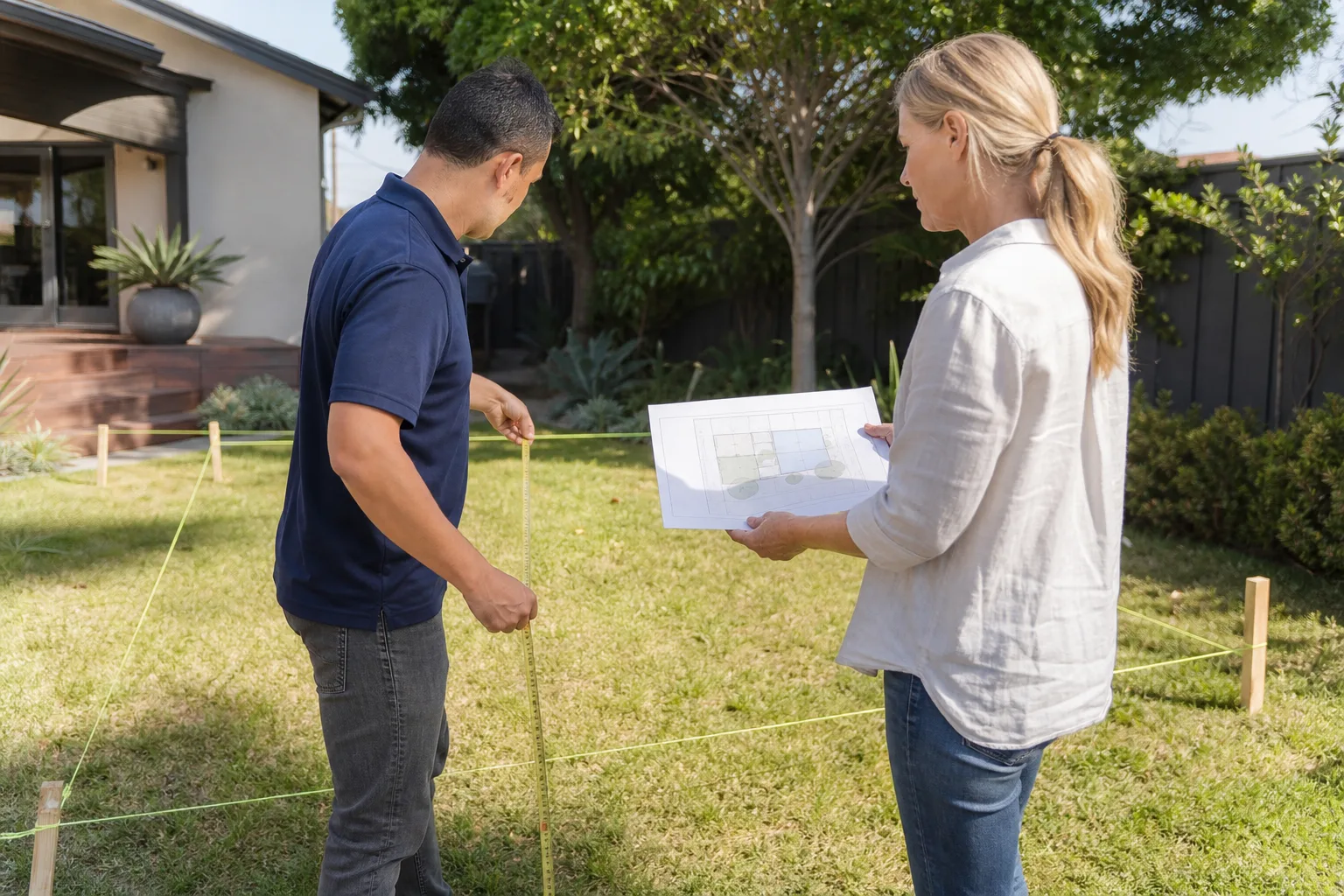
- Site plan drawn to scale showing the existing home, the proposed ADU, property lines, setbacks from all lot lines, easements, and the location of any trees larger than 24 inches in diameter. The city wants to see that the ADU footprint meets minimum side and rear setbacks – typically 5 feet in standard residential zoning, though corner lots and certain deed-restricted subdivisions differ.
- Floor plans with dimensions for every room, labeled use, window locations, door swings, and the path of egress from sleeping areas. The city checks for minimum room dimensions: an efficiency ADU in Houston needs at least one habitable room with 70 square feet of net floor area plus a separate bathroom if it is occupied by more than one person.
- Structural plans stamped by a Texas-licensed engineer. This is the piece that costs homeowners the most – a full structural packet for a detached ADU typically runs $2,800 to $6,500 in the Houston market, depending on foundation type and whether the unit is stick-built, panelized, or modular. Brands like Mighty Buildings, Boxabl, and Plant Prefab often include factory engineering in the purchase price, which can reduce this line item significantly.
- Energy code documentation (IECC 2015 with Houston amendments). Expect either a REScheck report or a third-party HVAC design showing the unit meets minimum insulation, window U-factor, and air sealing requirements. A ductless mini-split system is the most common choice for Houston ADUs under 800 square feet.
- Floodplain documentation if your address is in or near a FEMA-mapped flood zone. More on this below – it is the single biggest cause of permit delays in Houston.
- Payment of fees. The Houston Permitting Center fees for an ADU typically run $1,200 to $4,500 depending on square footage and valuation, plus a separate drainage review fee in the $350 to $700 range.
Current timeline reality: the Houston Permitting Center advertises a 15-business-day first review for residential projects in its Commercial Plan Review division, but actual first review times for ADU plans in the past 18 months have run 4 to 10 weeks, with an additional 2 to 4 weeks for each resubmittal if corrections are required. Budget 8 to 14 weeks from submission to permit issuance for a clean application.
And here is the part most guides omit: Houston now requires digital submission through the iPermits portal, with every sheet uploaded as a separate PDF with a consistent naming convention. A submission with the wrong file names or a missing drainage exhibit gets bounced before a human reviewer sees it. We have seen good plans sit for three weeks because the owner-name field did not match the Harris County Appraisal District record exactly.
FEMA Floodplain Rules and LOMA Letters: The Houston Variable
Houston is arguably the most flood-plain-adjacent major city in America, and FEMA rules affect more ADU projects here than anywhere else in Texas. If your property appears in a FEMA Special Flood Hazard Area – Zone AE, AO, or VE – the city will not issue an ADU permit until you submit floodplain documentation. For a new detached ADU in a flood zone, the standard requirement is that the finished floor of the living space sits at or above the Base Flood Elevation (BFE) for your specific lot.
This is where LOMA letters enter the picture. LOMA stands for Letter of Map Amendment – a document issued by FEMA that removes a single structure or parcel from the regulated flood zone when the land is actually higher than the flood map suggests. In Houston, where the FEMA maps are notorious for over-broad flood zone boundaries, a LOMA is often the fastest path to a buildable ADU. Here is the process:
- Order an elevation certificate from a Texas-licensed surveyor. In Houston this costs $500 to $900 and takes two to four weeks.
- If the elevation certificate shows your proposed ADU pad is above the BFE, your engineer files a LOMA application with FEMA. The application fee ranges from $425 to $900 depending on the structure type.
- FEMA review typically runs 30 to 60 days. A successful LOMA removes the federal flood insurance mandate and the city’s floodplain permit condition for your structure.
- If the LOMA is denied or the pad is genuinely below BFE, the ADU can still be built on a raised foundation or piers – but the foundation cost jumps $8,000 to $25,000 depending on how high you must go.
- Foundation inspection. For a slab foundation, the inspector checks the forms, rebar placement, vapor barrier, and the location of anchor bolts before concrete is poured. For a pier-and-beam foundation, the inspector checks the piers, beams, and floor framing. In Houston’s expansive clay soils, the foundation plan must show engineered slab reinforcement or pier depth – a standard residential slab is not automatically adequate, and the inspector will call out a plan that lacks a soils report if the address is in a known movement zone, which includes most of the city west of the 610 Loop.
- Framing inspection. This is the big one. The inspector checks wall framing, roof framing, shear wall nailing, hurricane strapping, window and door headers, and the fire separation between the ADU and any adjacent structure. Houston sits in a hurricane wind zone with design wind speeds of 110 to 140 mph depending on the specific area, so the strapping and anchoring details matter more than in Dallas or Austin. If your ADU shares a wall with the main house – a common configuration for home additions – the fire-rated assembly must be built per the approved plans, and the inspector will look for the specific drywall layers and fire caulking shown on the details.
- Final inspection. The inspector verifies the completed electrical, plumbing, and mechanical systems; confirms the smoke and carbon monoxide detectors are installed and working; checks egress windows in sleeping areas; verifies the finished floor elevation matches the approved plan; and signs off on the certificate of occupancy. In Houston, the final inspection must also pass a “pre-final” drainage check for sites where the grading plan was a permit condition.
- By-right construction. Cities can no longer require a special use permit or a public hearing for an ADU that meets the statutory size limit – currently up to 1,200 square feet or 60% of the primary dwelling’s gross floor area, whichever is less. This removes the single biggest process barrier: the discretionary hearing where neighbors could object and kill a project.
- Reduced parking requirements. The city can no longer require more than one off-street parking space for an ADU, and in many Houston neighborhoods, existing driveway width satisfies this without new paving.
- Design-review limits. Cities cannot impose architectural style mandates beyond what applies to the primary residence. The ADU can match or complement the main house; the city cannot require a specific material or style.
- What the bill did not change: setbacks, height limits, lot coverage maximums, floodplain rules, and utility connection requirements remain under local control. A Houston ADU still must meet the city’s 22-foot height limit in most residential districts and the 30% lot coverage maximum.
- Building before checking jurisdiction. The homeowner in the opening paragraph of this guide spent $62,000 before learning her Harris County address was not in the City of Houston’s permitting system. Check the jurisdiction lookup tool before spending a dollar on plans. Written confirmation from the permitting office costs nothing and takes one morning.
- Assuming a prefab ADU does not need a permit. Every ADU in the Houston area needs a permit, including units from Mighty Buildings, Boxabl, Plant Prefab, and Tuff Shed shells. The manufacturer’s engineering may reduce your plan review work, but it does not replace the city’s permit.
- Ignoring the floodplain overlay until plan review kills the project. Houston’s FEMA maps are broad. Pull the flood zone determination for your address in the first week, not the first month. A LOMA takes 30 to 60 days and must be filed early or it delays the permit by seven weeks.
- Skipping the deed restriction check. In Houston neighborhoods with active HOAs, an ADU can be blocked by covenant even if the city would approve it. Harris County will not check deed restrictions for you, and neither will the permit office.
- Underspecifying the structural package. Houston sits in a hurricane wind zone with expansive clay soils. A structural plan stamped for Dallas conditions will get bounced by a Houston plan reviewer. Use a Texas-licensed engineer familiar with coastal wind design.
- Treating the ETJ as a straightforward county project. ETJ properties in the Houston area routinely fall into a jurisdictional gray zone where the county and the city disagree on who reviews what. Get written confirmation of the reviewing authority before submitting plans.
- Assuming the permit fee covers everything. The permit fee is the smallest line item in the entitlement cost. Engineering stamps, elevation certificates, and third-party energy reviews cost far more. Budget the full range shown above, not just the permit counter fee.
We have built ADUs in Braeswood Place, Meyerland, and the Timbergrove area where the FEMA map said “flood zone” but the actual elevation said otherwise. In each case, the LOMA letter was the difference between a $5,000 survey-and-formality and a $25,000 raised foundation. One garage conversion in Meyerland required a LOMA because the existing garage slab sat 8 inches below the BFE – we raised the floor with a sleeper system and closed the permit in five weeks instead of twelve.
If your property is not in a mapped flood zone, you still need a drainage plan in the Houston permit packet. The city requires a site grading exhibit showing that the ADU roof runoff will flow to the street or a detention area, not onto a neighbor’s lot. This is non-negotiable and cheap – typically a one-sheet exhibit from your engineer.
The Three Inspections Every Houston ADU Must Pass
Once the permit is issued and construction starts, the City of Houston requires a series of inspections. The three that stop projects if they fail are foundation, framing, and final. Harris County and ETJ projects follow a similar pattern, though the specific requirements and inspector turnaround times vary – county inspections in Harris can be scheduled with as little as 24 hours notice in some precincts, while city inspections typically run 48 to 72 hours from request to arrival.
What inspectors actually look at – beyond the plan sheet – is workmanship consistency. If the framing nailing pattern is inconsistent, if the sheathing gaps exceed the spec, if the anchor bolts are spaced incorrectly, it signals shortcuts-one reason many homeowners weigh DIY vs Professional ADU: The Houston Homeowner’s Decision Guide before breaking ground. In Houston, where humidity and termites are constant factors, inspectors will also check for moisture barriers and termite treatment documentation.
How Texas SB 1412 Changed Local ADU Authority
Texas Senate Bill 1412, passed in 2023 and now fully in force, shifted some ADU authority away from municipalities and toward property owners. The bill provides that a city may not prohibit an ADU on a lot zoned for single-family residential use if the ADU meets certain state-defined standards. In practical terms, Houston homeowners now have a right to build an ADU that they did not have before – provided the unit meets the size, setback, and design standards in the state statute.
Here is what SB 1412 means for Houston ADU builders in 2026:
SB 1412 has not eliminated the local permit process. It has narrowed the reasons a city can say no. For Houston homeowners, this means an ADU that was legally impossible five years ago may now be buildable by right – but you still need a complete permit packet, and the city still reviews every drawing.
What ADU Permits Cost in Houston: Real Numbers
This is the section most homeowners read first, so here are the actual numbers we see in the Houston market in 2026. A typical detached ADU under 800 square feet inside Houston city limits costs $5,400 to $9,500 in hard permit and entitlement fees. A garage conversion typically runs $2,800 to $5,200, because the foundation and shell already exist. Here is the breakdown:
| Fee Item | Typical Range (Houston City Limits) |
|---|---|
| Building permit fee | $1,200 – $4,500 |
| Plan review fee | $350 – $900 |
| Drainage/stormwater review | $350 – $700 |
| Structural engineer stamp | $2,800 – $6,500 |
| Elevation certificate (if flood zone) | $500 – $900 |
| LOMA application (if needed) | $425 – $900 |
| Third-party energy review | $250 – $600 |
| Inspection fees (all three) | Included in permit fee, or $200 – $400 separately |
Outside city limits, Harris County fees are typically lower on the permit line item – $400 to $1,800 – but the county requires separate septic and floodplain review, and those fees can eat the difference. ETJ projects often carry the worst of both: county-level fees plus city drainage review. When we quote a permit budget for an ETJ property, we tell homeowners to plan for the Houston range plus $1,000 in buffer.
The point of these numbers is not to scare you off. It is to set the right budget before the first drawing. At Lodgewick ADU Houston, the written price we provide before any work starts includes the permit fee estimate as a separate line item, so you see exactly what the jurisdiction charges and what the construction costs. No surprises at the counter.
Common Mistakes to Avoid
When to Call a Professional
If your property shows any flood zone designation, any ETJ status, or any HOA deed restriction, call a Houston ADU specialist before drawing plans. The same applies if you are converting an attached or detached garage that was built before the 2000s – older slabs and wall framing often fail to meet current wind and seismic anchoring requirements, and the fix is cheaper when caught in the design phase. If you are considering a prefab unit from Mighty Buildings, Boxabl, or Plant Prefab, a builder with hands-on familiarity with those systems can tell you whether your lot, your soils, and your jurisdiction actually work with the factory drawings or whether a stick-built or panelized approach will clear plan review faster. Lodgewick ADU Houston offers free estimates in Houston with a written price before any work starts – call (361) 326-2313 to talk to a live person about your lot.
Frequently Asked Questions
A detached ADU permit in Houston city limits typically costs $5,400 to $9,500 including the permit fee, plan review, drainage review, and the structural engineer’s stamp. A garage conversion permit typically runs $2,800 to $5,200. Call (361) 326-2313 for a written line-item estimate on your specific lot – our estimates are free.
No. Every ADU in the Houston area requires a permit from the City of Houston, Harris County, or the applicable ETJ authority. Unpermitted ADUs get flagged at resale, often require demolition of finished work, and can void your homeowner’s insurance. The permit is not optional.
A LOMA (Letter of Map Amendment) is a FEMA document that removes your parcel from the regulated flood zone when an elevation certificate proves your land sits higher than the flood map suggests. You need one if your address is in a FEMA flood zone and the ADU pad is at or below the Base Flood Elevation. In Houston, LOMA review typically runs 30 to 60 days.
Plan for 8 to 14 weeks from submission to permit issuance on a clean City of Houston application. Flood zone projects add 30 to 60 days for LOMA processing. Harris County permits can move faster – 4 to 8 weeks – but ETJ projects often take the longest due to jurisdictional review overlap.
No. SB 1412 gives Texas homeowners a by-right path to build an ADU that meets state size and setback standards, but you still need a city or county permit with approved plans and passing inspections. What the bill eliminates is the discretionary hearing where neighbors could previously block a complying ADU.
Floodplain documentation. Houston’s FEMA maps are broad, and an ADU in a mapped flood zone cannot be permitted until the floodplain documentation is filed – either an elevation certificate showing compliance with the BFE, or a LOMA removing the structure from the flood zone. File this early. Call (361) 326-2313 and we will walk you through the flood zone determination for your lot.
The Bottom Line
Texas has no statewide ADU permit code. The rules that govern your project depend on a jurisdictional line most Houston homeowners do not know they are near – City of Houston, Harris County, or an ETJ. Your permit packet requires site plans, stamped structural drawings, energy code documentation, and potentially floodplain paperwork. The three inspections that matter are foundation, framing, and final. Recent legislation under SB 1412 has strengthened homeowner rights, but it has not removed the need for a correct, complete permit application. If you are planning an ADU in Houston, start with a jurisdiction check, pull the flood zone determination, and get a written price from a builder who knows the Houston process. For more guides & resources, visit our blog. That is the difference between a permit that clears in eight weeks and a frame that stands for eleven months while a different office’s inspector arrives.
Written by Russ Delmar, Owner at Lodgewick ADU Houston, serving Houston since 2010.